There's a specific kind of room that money builds when nobody stops it, and you've stood in it. Everything is expensive, everything is correct, and the whole thing is dead on arrival, because a room where every object cost real money reads as purchased, and purchased is the one thing money is never supposed to look like. The opposite failure is just as legible. What separates the rooms you remember from both of them isn't budget. It's allocation, the knowledge of which objects absorb money invisibly and which ones broadcast it, and it happens to be learnable.
Money Goes Where the Body Goes
Start with the half of the map that's almost physical law: money goes to whatever touches your body, because your body keeps a ledger your eyes don't. The sofa leads, and the spending should be nearly violent. Eight-way hand-tied springs, a kiln-dried hardwood frame, and down-wrapped cushions put you in a $9,000 to $14,000 conversation at makers like George Smith or Verellen, and the math holds up under cross-examination: that sofa runs twenty-five years, while the $3,000 version dies in four and bills you for its own replacement. The same logic covers the mattress, the chairs that host three-hour dinners, and the bedding, where $2,500 of Sferra and a wool topper will quietly outperform every luxury brand the algorithm has ever shown you.
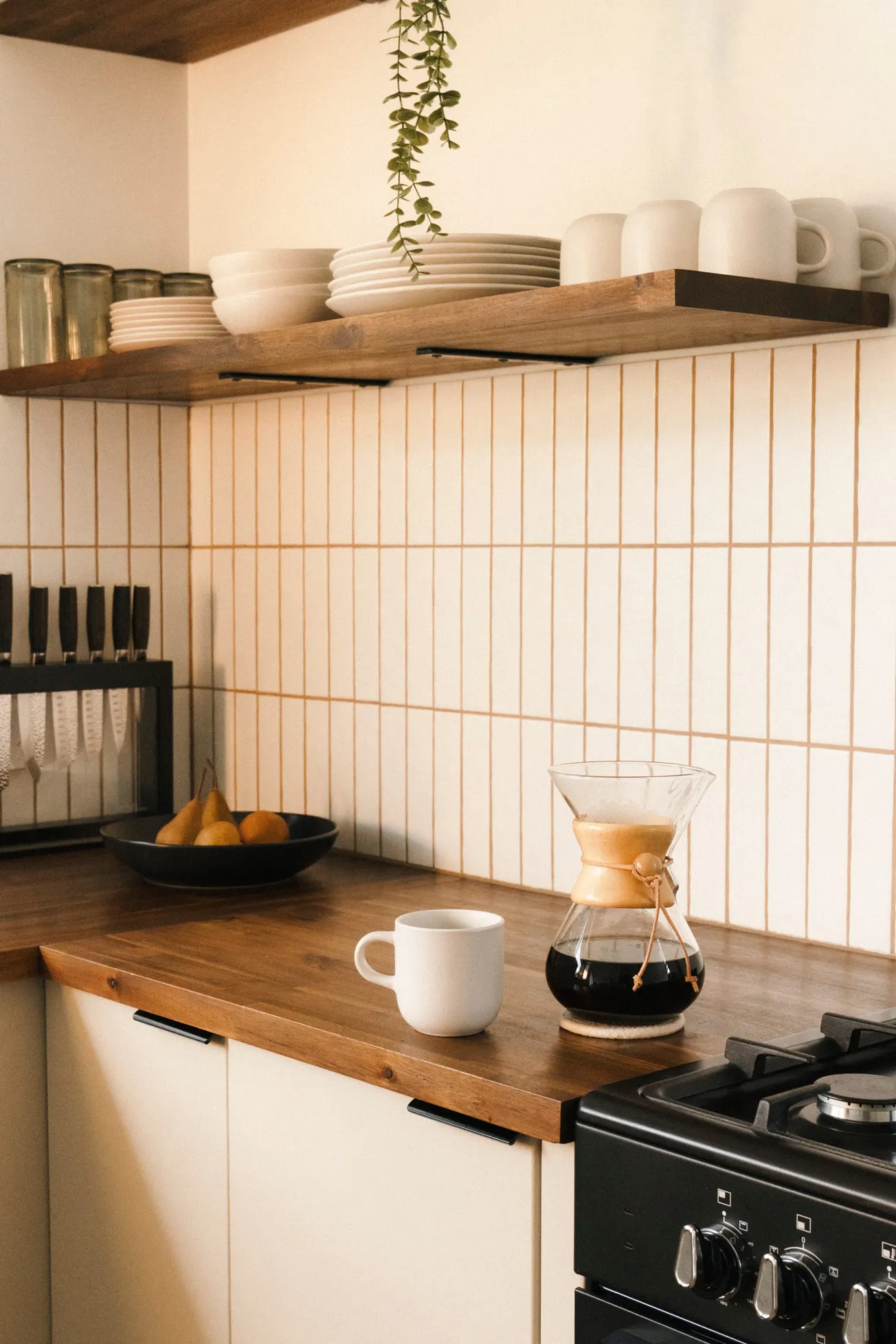
The corollary is less obvious and more diagnostic: spend on anything with a motor or a hinge. Drawers, doors, hardware, appliances. Moving parts are where cheap goes to be discovered, on a six-month delay. The $80 cabinet pull and the $8 one feel identical in the showroom; the difference is revealed every morning after, forever, in a kitchen that has decided to tell you the truth. Nobody sees a drawer glide. Everyone who lives with one feels it.
The Rug Is the Most Serious Object in the Room
Then the floor, which is where a real budget stops resembling the last one. The rug at this level isn't background; it's the most serious object in the room, the largest surface, the source of the palette, and, uniquely in all of furnishing, the purchase that can appreciate. An antique Oushak or a genuine Beni Ourain, and genuine means Morocco, wool with a faint memory of lanolin, an irregularity no factory would tolerate, runs $4,000 to $15,000 from an auction house or a serious dealer, and it will be worth more when your daughter takes it. The $1,200 homage is worth nothing the day it ships, and the people who know clocked it from the doorway, because the pattern is too regular and the pile is too polite. When the budget forces a choice between the rug and the sofa fabric, take the rug. Fabric can be redone. The rug is the room's provenance.
Custom window treatments belong in this tier too, interlined and hung high and full at $800 to $2,000 a window, and they're the clearest line in interiors between decorated and furnished: nobody can name what changed, and everybody feels it.
Permission to Cheat
Now the relief, because the other half of the map is permission. Side tables, coffee tables, consoles, and nearly every decorative object are where you cheat, and cheat proudly, because for these pieces vintage isn't the compromise, it's the upgrade. The estate-sale brass bowl is $60. The marble-top side table is $150 on Facebook Marketplace, from a seller who priced it like furniture instead of like history. The ceramic lamp that reads as $900 cost $80, the found object that every guest picks up cost less, and none of it should be new, because this category's entire job is to look discovered rather than delivered.
Cheat on trend pieces at any price, always; the accent silhouette of the moment holds a five-year lease on your taste no matter what it costs. And cheat on throw pillows, the highest-margin racket in the business, by pairing the $30 insert with a vintage textile cover instead of buying the $240 assembled opinion.
The Mix Is the Message
Which brings the map to its actual point, because the allocation was never just financial strategy. It's the aesthetic itself. The $60 bowl beside the $9,000 sofa isn't a budget concession; it's the sentence the room speaks: assembled over time, by a person, with an eye. The all-expensive room and the all-cheap room are both monologues. The mix is a life, and, not incidentally, it's the one version that can't be reproduced by anyone with the same catalog and the same credit limit, which at this level is the entire game.
So run the audit tonight, from the couch. Everything your body touches, the best you can manage. Everything with a hinge, better than it needs to be. The rug, the most serious thing in the room. And at least three objects in your eyeline that cost almost nothing and have a story. If the expensive things are quiet and the cheap things are interesting, it's done correctly. If it's the other way around, well. Now you have the map.