A Dossier: The Candle
THE CANDLE
A Dossier
She lights the same one every time.
Not the gift candle. Not the one that looked beautiful in the store. The one that works—that changes the room in a way she feels before she can name it.
(That instinct is introduced more quietly in The Candle · An Edit.)
There's a candle she's burned to the final quarter-inch three times now. She doesn't remember where she bought it. She doesn't think about it. She lights it at the same hour, in the same room, and something in her evening shifts. The day ends. The night begins. That's the candle.
Not the one she researched. Not the one someone recommended. The one that disappeared into her life so completely she forgot it was a purchase at all.
I wanted to understand why. What separates the candle she burns to nothing from the ones that sit half-used on a shelf, gifts she didn't choose, phases that passed?
Forty-one candles. Sixteen houses. Conversations with women who've burned the same scent for a decade, and women who collect candles and can't explain why none of them feel right. A chandler in the French Alps who ages materials for two years before pouring. A sixth-generation craftsman in Japan whose family has made candles the same way since the Edo period. Mills traced. Failures documented. The woman whose Diptyque Baies has scented every apartment she's lived in for fifteen years. The woman whose $185 candle tunneled by the third burn. The woman still lighting her mother's beeswax tapers from 1978.
This is what I found.
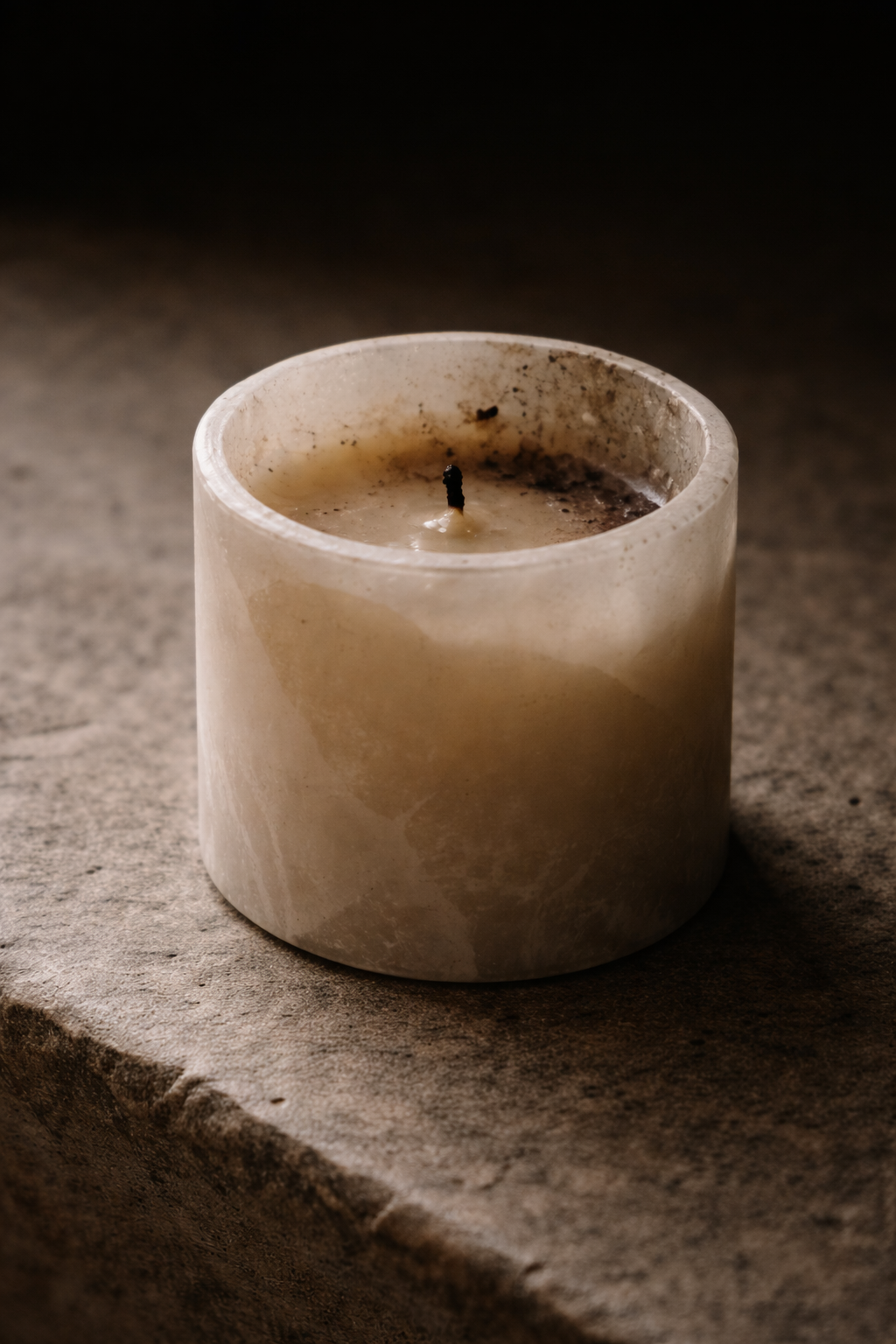
At Rest
This looks at candles after they’ve been lived with.
What She's Actually Sensing
A woman shopping at this level has been buying candles for years. She can tell when something is wrong. She doesn't always know why.
The difference between a candle that performs and one that disappoints is measured in fragrance load—the percentage of scent oil by wax weight. At 6%, a candle smells pleasant on the shelf and vanishes when lit. At 10–12%, it fills a room. Both labels say "luxury." Both prices say premium. One was formulated to sell. The other was formulated to burn.
She knew. She didn't have the language.
Here's what surprised me: her $70 Diptyque doesn't necessarily contain more fragrance than a $28 Voluspa. Industry standard is 6–10% regardless of price point. She's paying for fragrance complexity—the quality of the oils, the layering of notes, the nose who composed it—not quantity.
More fragrance isn't better. Overloaded candles self-extinguish. They "sweat" excess oil. They tunnel. They produce weaker scent, paradoxically, because there's insufficient heat to release fragrance from the saturated wax. A woman who's been disappointed by candles promising "triple scent" has encountered this physics. The marketing was the problem.
What separates the candle she burns to nothing?
It was formulated correctly. The fragrance load matched the wax blend. The wick was sized for the vessel diameter. Someone tested it—burned it through multiple cycles, measured the melt pool, adjusted. The candles that work aren't accidents. They're engineering that doesn't announce itself as engineering.
(The few objects that meet this standard are assessed quietly in The Candle · The Monclaire Guide.)
The Pattern That Emerged
I spoke to a woman who's burned Diptyque Baies in every apartment she's lived in since 2009. Fifteen years. Same candle. Same ritual. Her partner can identify her home from the hallway by scent alone.
This was the pattern I didn't expect.
The women who'd found their candle weren't rotating. They weren't collecting. They'd stopped looking because looking became unnecessary.
The science is specific: scent bypasses the brain's logical processing entirely. Olfactory signals travel directly to the limbic system—the amygdala, where emotion lives, and the hippocampus, where memory is stored. No other sense has this direct line. This is why a candle burned consistently becomes neurologically encoded as home—as specific as a voice, as recognizable as a face. The brain literally wires "this scent = this place."
Another woman described her mother's apartment. "She's burned Cire Trudon for as long as I can remember. When I smell it anywhere—a hotel, a friend's house—I'm immediately back in her living room. I'm twelve years old. I don't choose this response. It just happens."
The women interviewed who'd committed to a single candle described the same phenomenon. Guests commented before removing their coats. Children associated the scent with arriving. Partners noticed immediately when it was absent. Something's different. What changed?
That recognition can't be performed. It's accumulated. It takes months of the same candle, lit the same way, before it stops being something she buys and starts being something her home is.
What the Labels Actually Mean
Luxury candle language sounds precise. Much of it isn't.
"Hand-poured" has no legal definition. It simply means wax was poured by hand rather than machine. It doesn't indicate quality ingredients, natural wax, small batches, or careful testing. Large manufacturers can "hand pour" at industrial scale while using cheap paraffin and synthetic fragrance.
"Made with essential oils" typically indicates a trace amount—often under 5%—blended with synthetic fragrance. The economics are brutal: one pound of rose essential oil requires 10,000 pounds of roses. Essential oils also combust at high concentrations and burn off quickly when heated, leaving no scent throw. The candle that smells like rose almost certainly smells like a rose accord, not rose oil. This isn't deception. It's chemistry. Synthetics often outperform naturals for stability and throw.
Even wax terminology misleads. "Soy candle" may legally be only 51% soy. Diptyque's formulation charter states their candles are "composed primarily of mineral waxes"—paraffin is the primary ingredient. Luxury brands choose paraffin because it offers superior scent throw and cleaner burns. The "clean soy" narrative is marketing, not science. Professionals often prefer paraffin or blends for performance.

And here's what took me longest to verify: many luxury candles come from contract manufacturers. Bougies la Française, operating since 1902, supplies multiple luxury houses from the same facilities. The same workshop may pour one brand's "exclusive" candle one week and another's the next. This doesn't indicate poor quality—these are often excellent facilities with rigorous standards. It does mean the romance of solitary artisanship is frequently overstated.
The difference isn't moral. It's practical. She isn't paying for wax. She's paying for decisions: what was prioritized, what was tested, what was allowed to take time.
The Houses That Tell the Truth
Some houses tell you exactly what you're getting. This transparency became its own signal of quality.
Diptyque publishes a formulation charter. They claim to never use synthetic fragrance—genuinely exceptional, and it explains part of their pricing. Their candles use eight mineral wax blends, each matched to specific scent families. Their wicks are pure cotton, tested for each vessel diameter. The brand began in 1963 when three friends opened a shop at 34 Boulevard Saint-Germain and started making candles because they couldn't find ones they liked. Baies—blackcurrant and Bulgarian rose—has been the bestseller for decades. Cold throw so strong it scents rooms unlit.
Cire Trudon was founded in 1643. They supplied the French court at Versailles. Napoleon's correspondence references their candles. The house has been making candles longer than the United States has existed. Their hand-blown Tuscan glass vessels, their vegetable-based wax, their cotton wicks calibrated by hand—none of this is marketing. It's documentation. Some editions feature 24-carat gold leaf interiors. The house represents what luxury meant before the word became meaningless.
Le Labo discloses everything: 100% soy wax, specific burn times, concrete vessels that distribute heat evenly. Their Santal 26 polarizes initially—many women find it challenging on first encounter—but develops what devotees call "acquired taste devotion." The staying power is exceptional. "It travels all over the house and stays there," one woman told me. She'd burned it for eight years.
Byredo uses black wax and mouth-blown glass. Their burn times are published. Their vessels are engineered thick enough to prevent heat damage to surfaces—a detail most houses ignore. Bibliothèque layers peach, plum, vanilla, patchouli, and leather into something that reads as "old library"—users describe the scent as lingering through the following day. Tree House—cedar, bamboo, sandalwood with leather and myrrh—has developed a following among women who use it specifically as an evening ritual, lit at the same hour to signal the end of the workday.
The houses that document their process aren't bragging. They're building trust. They're saying: this is what you're getting, and we'll stand behind it.
The Tier Beyond the Counter
There is a tier of candle making that sits outside the modern luxury system entirely.
These makers don't scale. They don't market. They control every stage of production and cannot mass-produce without losing what makes them worth seeking. They don't appear on gift guides. They don't want to.
In Japan, only approximately twenty craftsmen still practice traditional warosoku making. At Omori Warosoku in Ehime Prefecture, sixth-generation maker Taro Omori and his son Ryotaro create candles using genuine sumac tree wax, washi paper, and igusa rush wicks—100% plant-based, heated over charcoal fires unchanged since the Edo period. Each candle shows faint "growth ring" patterns from a hand-coating technique where craftsmen dip bare hands into melted wax, building layers one at a time. Matsui Candle Atelier, established 1907, requires fifteen different production steps, some requiring multiple cycles before completion.
These candles burn differently—steadier, quieter, with a softer light. They cannot be replicated by machine. A woman who lights one lights something made the same way for four hundred years.
Mad et Len operates from the French Alps on a different principle entirely. Founders Sandra Fuzier and Alexandre Piffaut age raw materials naturally—some take up to two years to reach olfactory perfection. They source all essential oils themselves, never dilute with carrier oils, produce only limited batches. Each candle is signed by hand, dated, weighted. The vessels are hand-hammered steel and blackened iron, made by blacksmiths in Morocco and Mauritania using ancestral methods. Terre Noire captures primal damp earth and humus in a way industrial perfumery cannot replicate. €70–250, available through Aedes Perfumery and direct. When it's gone, it's gone until the next batch ages properly.
Apis Cera in Provence represents what happens when one person controls the entire process. Founder Charles van Valkenburg takes one to two years to perfect each product before launching; his collection is deliberately small. Using 100% pure beeswax with no additives, no coloring, and cotton wicks, he hand-rolls each Lucienne candle and custom-molds each Ambroise pillar. The scent is beeswax itself—honey and pollen, varying subtly by season.
In Umbria, a single maker in the medieval town of Collepino creates duplero-style candles using 100% beeswax and untreated hemp wicks. The natural scent varies as wild-harvested pollen changes with the flowers in bloom. One person controls everything from hive to pour.
Cereria Giovanelli in Trentino-Alto Adige has operated since the eighteenth century, using a traditional "giostra"—carousel—for hand-dipped candles. Production was suspended during both World Wars. Resumed each time. The woman who lights one lights something that survived.
The arbitrage isn't in finding a lesser-known candle from a famous house. It's in knowing which houses exist outside the algorithm entirely.
The Thirty-Second Test
She can verify more than she thinks before lighting a candle.
Tap the wax surface with her finger. If it yields immediately, the candle is heavily paraffin-based—not a flaw, but information. Firmer wax tends to burn slower. This is the candle equivalent of pinching the fabric.
Feel the weight relative to size. Heavier indicates denser wax, typically slower-burning. Check color consistency: quality candles have color running throughout; mass-produced candles often have a white core with only a colored outer layer from dip-coating.
Examine the wick. It must be centered and straight—off-center wicks cause uneven burns and soot. Look for thinly braided cotton or wood. Avoid metal cores.
Cold throw—the scent before lighting—reveals something, but not everything. Strong cold throw doesn't guarantee strong hot throw. Lighter notes like citrus and florals project well cold; deeper notes like vanilla and musk reveal themselves only when burning.
Red flags visible before purchase: "Triple scented" claims—a marketing term with no standard meaning. Oil visible on the surface—over-fragranced, will burn unevenly. No burn time estimate—the house hasn't tested it properly.
Now she knows what to feel for.
The First Burn
The candle was designed for the opening. The first light. The store experience. The moment of purchase.
No one designed for the life of the thing.
The first burn determines everything. If she doesn't allow the wax to melt completely to the container edges, she creates "tunneling"—the candle remembers that incomplete melt pool and never burns evenly again. Wax has memory. One mistake, permanently encoded.
Most luxury houses don't print this on their packaging. An $185 candle can tunnel irreparably because no one mentioned a first-burn rule that determines success or failure.
Time formula: burn one hour per inch of candle diameter. A three-inch diameter candle requires a three-hour first burn. A quality candle achieves full melt pool within two to four hours.
After the first burn, the tells are clear. Flame height between half an inch and one inch—taller indicates a wick problem. Minimal soot on the vessel walls. Wax consumption that's even, with no tunneling. Bowl-shaped residue around the edges indicates wax that won't fully consume—she's losing product.
Trim the wick to one-quarter inch before every burn. This alone extends candle life by up to 25%. Maximum burn time: four hours per session. Longer causes wick overheating and faster consumption. Stop burning when half an inch remains—prevents cracking.
The women I spoke to—the ones who burn the same candle for years—all knew these rules without being taught them. They'd learned by failure. By candles that disappointed. By expensive vessels that tunneled and modest ones that performed. The physics exists whether or not the label explains it.
What the Candle That Works Says About Her
The industry designs for impulse. For gift-giving. For the aesthetic of a candle on a shelf, photographed, admired, never lit.
The woman who finds her candle—the one she burns to nothing, over and over—has opted out of that system. She isn't collecting. She isn't decorating. She's using an object the way it was designed to be used, and she's discovered what most marketing hopes she won't: that one candle, burned consistently, does more than twenty candles rotated for novelty.
She's decided her evening is worth a ritual. That the transition from day to night deserves a marker. That the room she comes home to should smell like her home, not like a store, not like a gift, not like someone else's idea of what her life should smell like.
The candle that works says she's paying attention to her own experience. That she trusts what she senses over what she's sold. That she's willing to commit to something she's tested herself.
The industry would prefer she keep shopping. The candle that works lets her stop.
The Reach
She doesn't remember the research. She doesn't think about fragrance load or wax type or whether the wick is cotton or wood. She doesn't remember that Cire Trudon supplied Versailles or that Mad et Len ages materials for two years or that there are only twenty warosoku masters left in Japan.
She lights it at the same hour, in the same room, and the day ends.
The women I spoke to—the ones who've burned the same candle for a decade—all said some version of the same thing. I just knew. They didn't know why. They didn't need to.
The candle that earns the reach is the one that works so completely she forgets it's working.
The room changes. The evening begins.
She's already home.
Forty-one candles. Sixteen houses.
Houses referenced:
Apis Cera · Byredo · Cereria Giovanelli · Cire Trudon · Diptyque · Le Labo · Mad et Len · Matsui Candle Atelier · Omori Warosoku · Voluspa
Modern Monclaire maintains no commercial relationships with any brand, candle house, or chandler. This publication accepts no advertising, affiliate revenue, or sponsored content.
RELATED READING
FROM the edit
FROM the dossiers
The Scent · A Dossier
The Carafe · A Dossier
The Watch · A Dossier
