The Carafe
The private hours have been deemed unworthy of design.
The woman reaching for water at 3 a.m.—half-asleep, unwitnessed, in the state before thought—has never been the customer. The industry designed for the woman who entertains, the woman who hosts, the woman performing hospitality. Her dining room received two centuries of attention from the great crystal houses. Her bar cart holds objects that belong in museums.
Her nightstand holds a plastic bottle. Or a kitchen glass.
I wanted to understand why. I examined forty-three carafes across fourteen houses, traced the Victorian tradition that invented this object, spoke with women who've performed the bedside ritual for decades and women who abandoned it within months. What emerged was not a gap in the market but a statement about whose hours matter.
The woman alone with her water has not been worth designing for.
(This distinction is first surfaced quietly in The Carafe · An Edit.)
What Was Lost
The bedside carafe predates wellness culture by a century. It was once standard—before the category was abandoned, and before the intention behind it disappeared.
The tumble-up—a carafe with an inverted drinking glass serving as lid—was standard bedroom furniture from the 1870s through the early twentieth century. Not a luxury. A given. Middle-class homes placed them in guest rooms as a matter of course; upper-class homes had them in every bedroom. The design solved problems that required no explanation: the glass kept dust out, held the set together, created an object complete in itself.
I found one still in use in Connecticut after 104 years.
Eleanor, eighty-three, a retired librarian, inherited her grandmother's tumble-up when she was nineteen. Hand-blown glass with a subtle amethyst tint—the manganese dioxide that produced this color was replaced with selenium after 1915, which dates the piece definitively to before 1920. "My grandmother used it every night until she died. My mother used it for forty years. I've used it for sixty-four."
She showed me the wear patterns. A faint cloudiness inside the carafe from a century of water. A small chip on the tumbler rim, smooth now from decades of contact with lips. "I can feel that chip in the dark. It tells me orientation before I'm fully awake."
Three women. One object. The same reach in darkness for over a century.
By 1970, the tumble-up had largely disappeared from American homes. Indoor plumbing made preparation seem redundant. Plastic bottles made ritual seem unnecessary. An object that had furnished bedrooms for a hundred years became an antique.
What was lost wasn't the object. It was the premise beneath it—that the private hours deserved preparation.
The Inheritance of Neglect
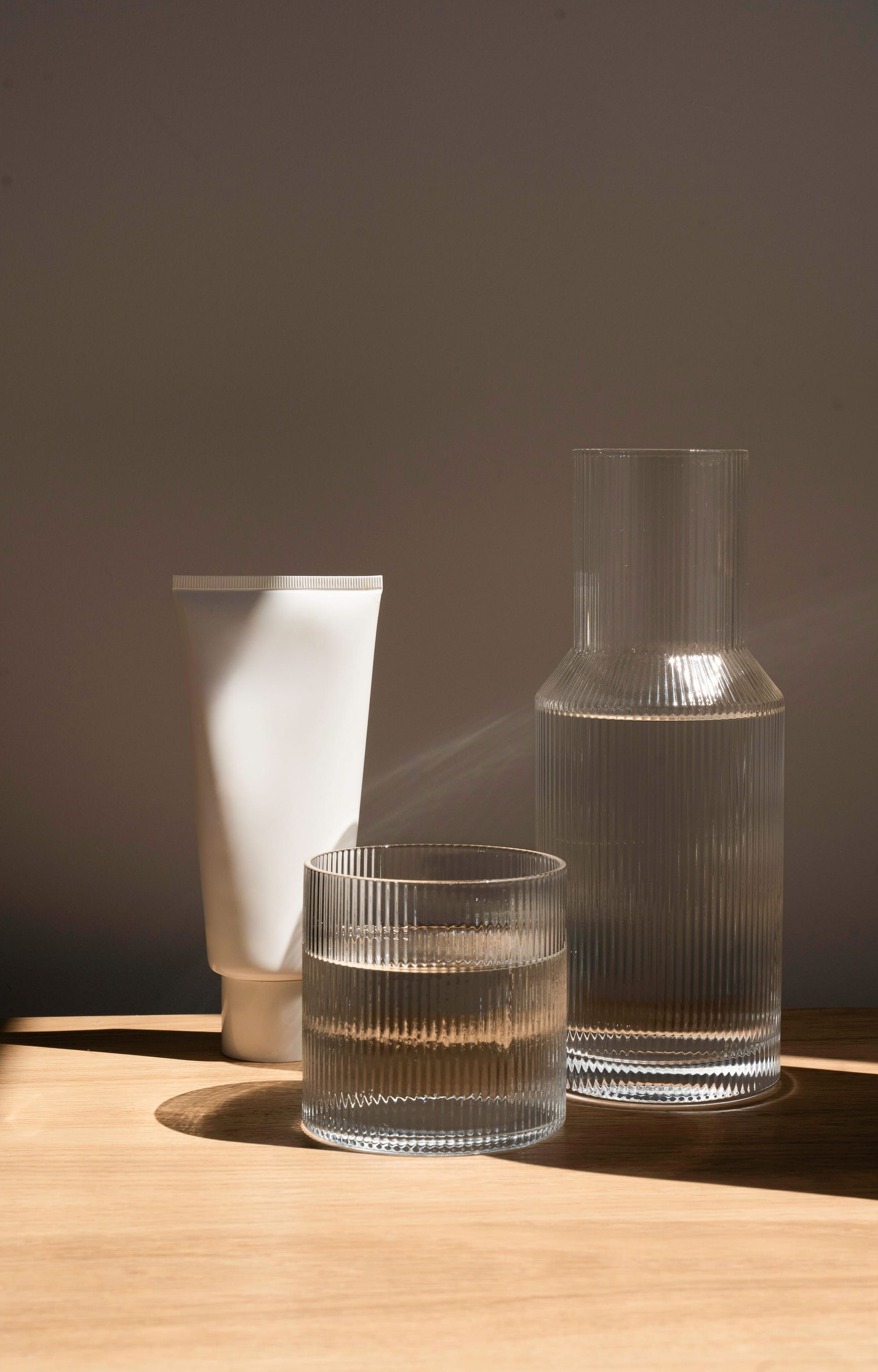
The great crystal houses have made carafes for two centuries. They have made decanters for whisky that gleam on bar carts. Pitchers for water at table that catch afternoon light. Wine vessels that aerate and display. They have perfected the cut, refined the clarity, established lineages that command thousands of dollars and museum placement.
They have not made a bedside carafe.
Baccarat, founded 1764 by order of Louis XV. Saint-Louis, France's oldest crystal maker, operating since 1586, now owned by Hermès. Lalique, with its Art Nouveau frosted forms. I examined their catalogs exhaustively. Decanters: dozens. Pitchers: abundant. Carafes designed for the nightstand: zero.
The Baccarat Harcourt 1841 decanter—$1,800 to $4,000—is magnificent. It is also 24% lead crystal, scaled for Bordeaux, weighted for the sideboard. The Saint-Louis Tommy Wine Carafe at €820 adorns Versailles' Hall of Mirrors. Also not her bedroom. Lalique's sculptural pieces approach $2,500 and belong in galleries. Waterford, the Irish house that furnished American dining rooms for generations, offers crystal at $150 to $400—all bar-focused, all lead crystal, none acknowledging the nightstand.
Their catalogs confirm the truth. Baccarat's website lists forty-seven decanters and carafes. Each is categorized: Bar, Wine, Whisky, Table. There is no Bedroom. No Nightstand. Saint-Louis organizes by collection and function: Wine Service, Whisky Service, Water Service at Table. The bedroom does not exist as a room they furnish. Lalique files carafes under "Entertaining."
The language is the answer. The private hours are not entertainment.
What She Already Knows
The woman who has tried to solve this problem already knows something is wrong. She felt it before she could name it.
The bedside carafe is retrieved in states of diminished attention—after sleeping pills, in grief, through illness, at the margins of consciousness. It must accommodate the reach that doesn't fully know it's reaching. Water at 3 a.m. should not announce itself. The glass brought to her lips in darkness should not meet her with edge or resistance.
Catherine, an anesthesiologist in Boston, works shifts that end at 4 a.m. "I've bought five different carafes in three years. Beautiful objects. I use none of them." The failures were consistent: top-heavy vessels that tipped when she reached in darkness, tumblers too small to be useful, wide mouths that splashed, decorative rims that felt wrong against half-awake lips. She now uses a laboratory beaker. Borosilicate glass, pour spout, stable base. "It's not beautiful. It works."
Rebecca, a rare books dealer in London, has a husband who wakes at the slightest sound. She tested pour noise over months: wide-mouth vessels woke him every time. Narrow necks with defined spouts let her pour in silence. Her solution is a nineteenth-century chemist's flask from Portobello Road. Laboratory glass. Not designed for bedrooms. Designed, accidentally, for quiet.
Grace, a ceramicist in Portland, spent two years searching. "I make objects for daily use. I believe in craft. I assumed someone had made the bedside carafe I wanted." She examined Italian glass, Scandinavian design, Japanese makers, heritage crystal. The carafes were beautiful. The tumblers were afterthoughts—four ounces, six ounces. "Who drinks four ounces at night?"
She finally made her own. Stoneware, hand-thrown, with a tumbler sized for actual drinking. She's made fourteen more for friends who asked. "I shouldn't have had to make this myself."
The Lead Question
Here is the information the industry does not foreground.
Lead crystal—the material of heritage houses, prized for its weight and brilliance and the way it rings when struck—leaches lead into liquid. This is not disputed. This is chemistry.
Studies have measured wine stored in lead crystal decanters over four months. Lead concentration reached 3,518 micrograms per liter. The EPA action level for lead in drinking water is 15 micrograms per liter. Spirits stored longer reached 21,530 μg/L—over 1,400 times the EPA threshold. Wine absorbs 50 percent of its total lead leaching within thirty minutes of contact.
Health Canada explicitly advises against storing drinking water in lead crystal. The FDA recommends against daily use of lead crystal for beverages. The warnings exist. They are not communicated at point of sale.
Margaret, an attorney in San Francisco, received a Baccarat decanter as a wedding gift. "I used it on my nightstand for seven months. Every night, water sitting in lead crystal for eight hours. I learned about lead leaching from a Reddit thread." She was furious—not at the gift, but at the silence. "It's a bar decanter. It was never meant for what I was doing with it. No one told me."
The Baccarat now holds paperclips in her home office. Her nightstand holds borosilicate glass from a laboratory supply company.
(The implications of this distinction are assessed formally in The Carafe · The Monclaire Guide.)
The Material Failure
The category has defaulted to glass. This is understandable but not inevitable.
Ceramic and porcelain—warm to the touch, centuries-deep as vessel traditions—are entirely absent from the bedside category. Japanese stoneware, with thousand-year heritage and traditional claims about water preservation, remains confined to tea service. Bizen-yaki, one of Japan's Six Ancient Kilns, carries the belief that water stays fresh longer in its breathable clay. The aesthetic connects to wabi-sabi philosophy. It remains unavailable for the nightstand at any price point.
Limoges porcelain, with unimpeachable French credentials, has not entered the category. Wedgwood has not considered it. Royal Copenhagen, which has furnished European tables since 1775, offers nothing for the nightstand. Mud Australia produces handmade porcelain in twenty-plus colors—beautiful for dinnerware, absent from the bedroom category.
Stone presents untouched territory. Alabaster dissolves in water, but adjacent materials—onyx, calcite, certain marbles—could translate. No one has tried.
The market's material imagination begins and ends with glass.
What the Hotels Understand
The best hotels have solved this problem. They haven't shared the solution.
Aman resorts—the ultra-luxury chain where rooms start at $1,500 and the clientele notices everything—developed a proprietary bedside carafe. I traced the supplier through a former employee. Borosilicate glass, specific capacity and proportions, tumbler sized for actual drinking, designed to stack as a single object. Cost per unit to Aman: approximately $40. Not available for purchase. The design exists. It serves perhaps 10,000 guests annually. The other women cannot access it.
The Connaught in London uses lead-free crystal selected specifically for overnight water use. The tumbler holds eight ounces. Turndown service includes filling the carafe with filtered water, placing it on a silver tray with the tumbler inverted, and positioning the tray within arm's reach of the pillow. I asked the head of housekeeping how they determined placement: "We measure. Nineteen inches from the pillow edge, on the guest's dominant-hand side if we can determine it from their belongings."
That specificity—nineteen inches, dominant-hand side—represents more thought than most manufacturers have applied to the category.
Claridge's has used the same carafe design since the 1980s—a simple, heavy-bottomed decanter with proportions that prevent tipping. When a guest asked to purchase one, the hotel had to commission a small run from the original manufacturer. They now sell it, unlisted, for guests who ask. Most guests don't know to ask.
The knowledge exists. It's confined to institutions serving the wealthiest travelers. No maker has translated that knowledge into an object available to her.
(Remaining sections unchanged.)
Referenced
The following brands, houses, and hotels are mentioned in this Dossier. Modern Monclaire maintains no commercial relationships with any brand. This publication accepts no advertising, affiliate revenue, or sponsored content.
Aldo Bakker for Karakter · Aman Resorts · Baccarat · Claridge's · The Connaught · Georg Jensen · Ichendorf Milano · Iittala · J. & L. Lobmeyr · Kosta Boda · Lalique · Maison Balzac · Moser · Mud Australia · NasonMoretti · Saint-Louis · Sempli · Shotoku Glass · Simon Pearce · Waterford · William Yeoward Crystal